
OVERVIEW
OF THE RICHMOND BAY TRAIL
See the Jan 31, 2008 San
Francisco Chronicle article: Richmond
Shoreline Parks: Trails and history
The
San Francisco Bay Trail is a planned 500-mile recreational
and transportation corridor encircling San Francisco and
San Pablo Bays. Authorized by State legislation in 1987,
cities and counties developed the Bay Trail Plan in 1989
under the auspices of the Bay Trail Project of the Association
of Bay Area Governments (ABAG). Overall, about 58% of the
Bay Trail has been completed.

In 2000, the Richmond City Council adopted Resolution 2-00 stating:
- “The Bay Trail will make Richmond a better place to live and work by creating new recreational opportunities for bicycling, walking, running and roller skating. facilitating access to shoreline parks, allowing residents to walk and bicycle between neighborhoods, and reducing automobile traffic and congestion.”
- “The Bay Trail will provide economic benefits to Richmond by showcasing Richmond’s beauty and recreational values, attracting visitors and new residents, and contributing to a climate that attracts new business.”
Richmond
has 32 miles of shoreline -- more than any other city on
San Francisco and San Pablo Bays. With 24.9 miles of Bay Trail
now in place, Richmond stands out as having more Bay Trail built
than any other City. The Bay Trail now links all of the parks along
Richmond’s Southern Shoreline connecting Point
Isabel with Miller/Knox
Regional Shoreline via the City’s Marina
Bay parks -- Shimada, Marina Bay, Barbara & Jay Vincent
and Lucretia Edwards (where you may take
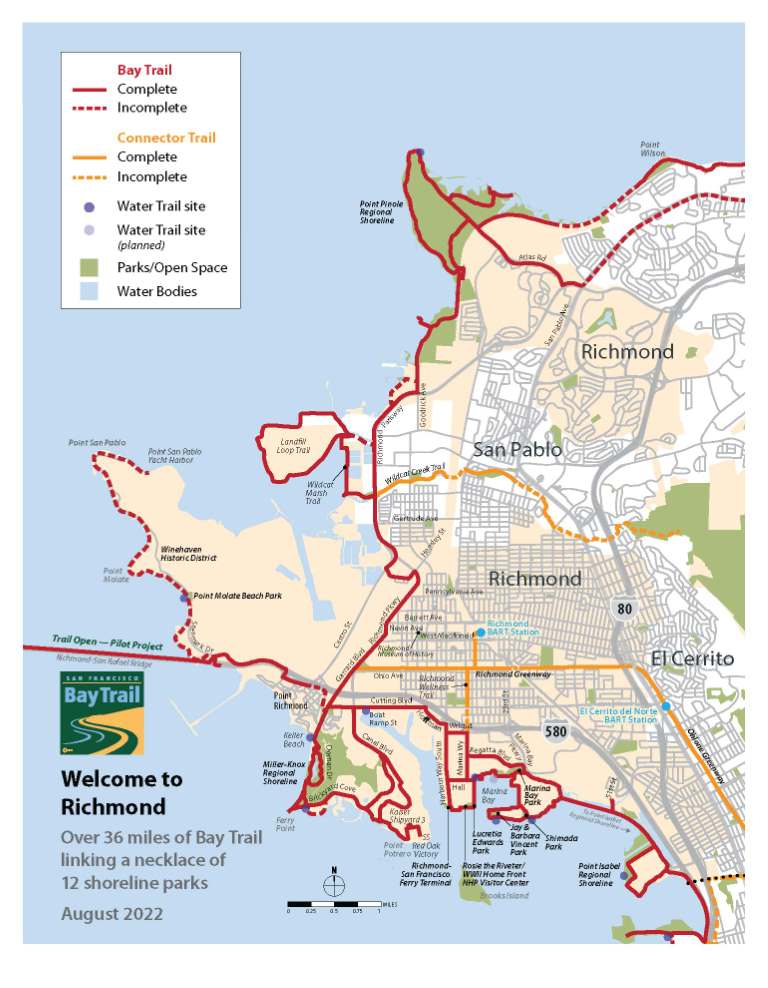
a self-guided Bay Trail walking/biking tour). Download
a high resolution map of Richmond’s built and planned Bay
Trail routes.
Credit
for the 24.9 miles of Bay Trail now built goes to the City
of Richmond and the East
Bay Regional Park District, as well as private
development projects which incorporated important Bay Trail segments
thanks to encouragement by the City and BCDC. Completing
Richmond’s remaining 16.3 miles of planned Bay Trail will
be challenging and time consuming.
Closing each gap will require
access to land, planning studies, CEQA compliance, construction
design and funding for each of these steps, as well as for construction
itself. Cooperation of the private sector will be critical since
many of the remaining gaps are located on private lands.
Download the
2008
Richmond Bay Trail New Year Report >>
To receive these and other hard copy progress reports on Richmond’s Bay Trail, as well as announcements of special events, send an email to TRAC, the Trails for Richmond Action Committee .
Photos
this page courtesy of Bob Walker and Ellen Gailing |