
Bay Trail Backers Sue State, Chevron Over Richmond Wharf
By Richard Brenneman
Bay Trail advocates have sued the State
Lands Commission (SLC) and Chevron U.S.A., challenging the agency’s decision to
renew the lease for Richmond’s Long Wharf Terminal.
The action, filed in Alameda County Superior
Court March 5, seeks to reverse the commission’s Jan. 29
vote to give the oil company a 30-year renewal on its lease for
the pier that serves as the entry point for all the oil processed
at Chevron’s
vast Richmond refinery complex.
The terminal is central to the operation
of the refinery, Richmond’s
largest and most controversial industry.
Oakland attorney Stephan Volker filed the action on behalf of
the Trails for Richmond Action Committee (TRAC), Citizens for East
Shore Parks (CESP) and Daniel P. Dollestedt.
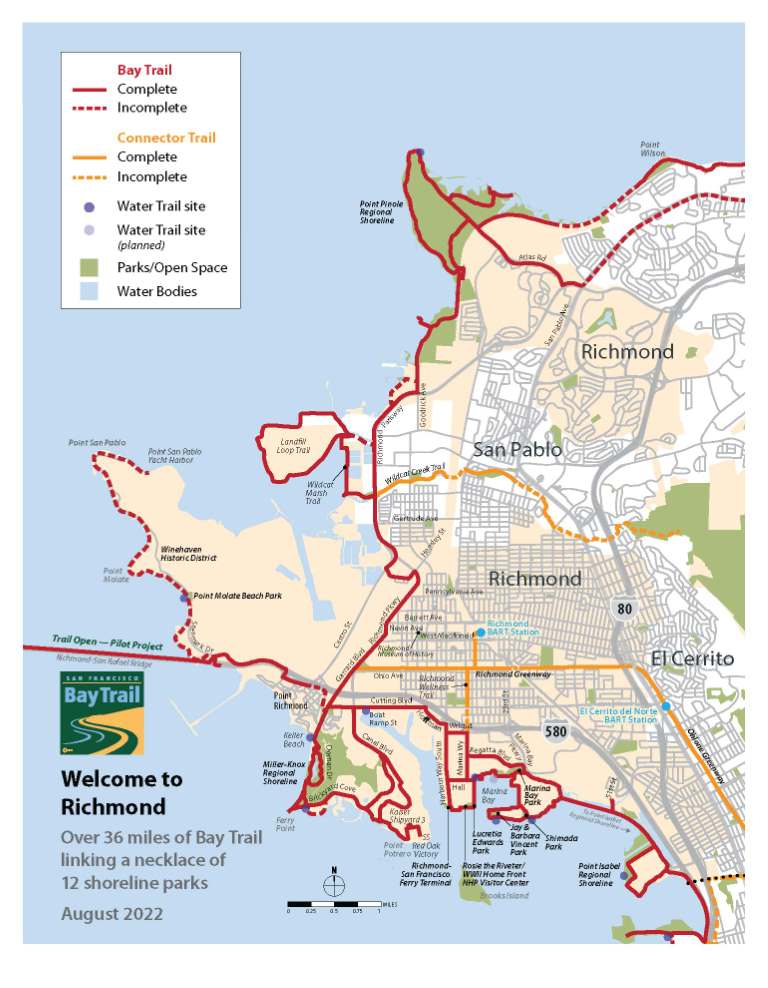
Both CESP and TRAC have been struggling
with the oil giant to extend the Bay Trail through the refinery’s
property, and Dollestedt is a paraplegic who sustained his injuries
on Sept. 24, 2006, while bicycling on a section of the shoulder
of Interstate 580 which serves as a section of the trail.
The action, filed under the California
Environmental Quality Act (CEQA), seeks to invalidate the environmental
impact report (EIR) used to justify the lease renewal and asks
for a ruling declaring that the commission’s certification
of the EIR and approval of the lease were invalid.
The suit also seeks reimbursement for attorney fees and litigation
costs.
“TRAC has existed for 10 years, all of it trying to complete
the Bay Trail through Richmond,” said Bruce Beyaert, the
organization’s chair.
“We’ve never considered litigation
before, because we prefer to accomplish our goals through friendly
persuasion, working with local governments and private enterprise.
It was with very great reluctance that we finally decided to
sue.”
The Long Wharf Terminal was built in 1902 by Pacific Coast Oil,
extending 3,440 feet parallel to the shoreline and connected to
the land by a 4,200-foot-long causeway. The massive project was
built above and into publicly owned submerged, tidal and shoreline
land.
Standard Oil Company of California bought the wharf and causeway
along with the refinery in 1905, with the company becoming Chevron
with the breakup of the parent company in 1984.
The Long Wharf complex operated without a lease from the state
until 1947, when the oil company signed a 50-year agreement a year
after the original wooden structure was replaced with a concrete
construction.
According to plaintiffs, the SLC, which
negotiates contracts for all private uses of public lands, evaded
the requirements of CEQA for 12 years after the original lease
expired by delaying the start of work on the EIR until 1998 and
delaying certification until Jan. 29 of a so-called “finalizing addendum” in
a meeting held at the Hotel Mar Monte in Santa Barbara.
The lease approved by the commission requires the oil company
to pay $870,000 a year, plus $5.8 million to cover the 12 years
when Chevron operated the pier without an agreement. In addition,
the lease was backdated to a start date of July 1, 2006.
In a subsequent action Feb. 4, the agency approved certification
of the entire EIR, according to the complaint.
The three-member commission is chaired by Lt. Gov. John Garamendi,
with the other two positions held by State Controller John Chiang
and Director of Finance Michael C. Genest. Garamendi and Chiang
both attended the Jan. 29 meeting, while Genest was represented
by Tom Sheehy.
The lawsuit contends the commission’s actions violated
the Public Trust Doctrine by either failing to renew the lease
or to seek “relevant and adequate mitigation of the resulting
harm,” including impacts to resources, navigation and recreational
uses.
Incomplete?
The second cause of action cites a series
of the EIR’s
alleged violations of CEQA, including a failure to adequately describe
the wharf project by omission of the refinery itself from the description.
The suit also contends that rather than
describing the lease as the continuation of an existing project—the legal term
for the subject of an EIR—the document should have treated
the agreement as an entirely new project, given that there was
no lease in place after the existing agreement had expired in 1997.
The suit also charges that the EIR failed
to consider the “numerous
inconsistencies between the Project and local and regional plans,” citing
five plans that called for extension of “a safe new segment
of the Bay Trail around the Long Wharf and its associated facilities.”
Other allegations include failure to
provide adequate alternatives and mitigation measures, failure
to consult with the California Coastal Conservancy, “a responsible agency, as required
by CEQA,” failure to adequately respond to public comments
and failure to adequately address cumulative impacts of the renewal.
“We think they got some bad legal advice,” said
Beyaert.
Volker said completion of the Bay Trail was critical for the
safety of the recreational users.
Dollestedt and a friend, Dan Weinstein, were biking the Bay
Trail to Point Richmond along the dangerous segment which uses
the freeway shoulder. Since Chevron owns the land on either side
of the freeway and has refused to allow an extension of the trail
through the area, claiming refinery security overrides public safety.
Weinstein was fatally injured and Dollestedt critically injured
when a car swerved out of control and struck the two cyclists as
they were cycling along the freeway shoulder.
“The very least Chevron could do is provide for a trail
that would prevent similar accidents in the future,” Volker
said.
The attorney said the commissioners had indicated they favored
an agreement to allow a trail extension during an earlier session
last year, but had reversed course by the time of the January meeting.
Asked for a comment on the litigation,
Chevron spokesperson Brent Tippen said, “Chevron believes the State Lands Commission
fully and properly considered Chevron’s request for renewal
of the lease and that its decision to approve the issuance of the
lease was correct. Period.
|