
During a hometown visit with his wife and two girls
last month, software engineer Dan Weinstein went for a bike ride
with a childhood friend.
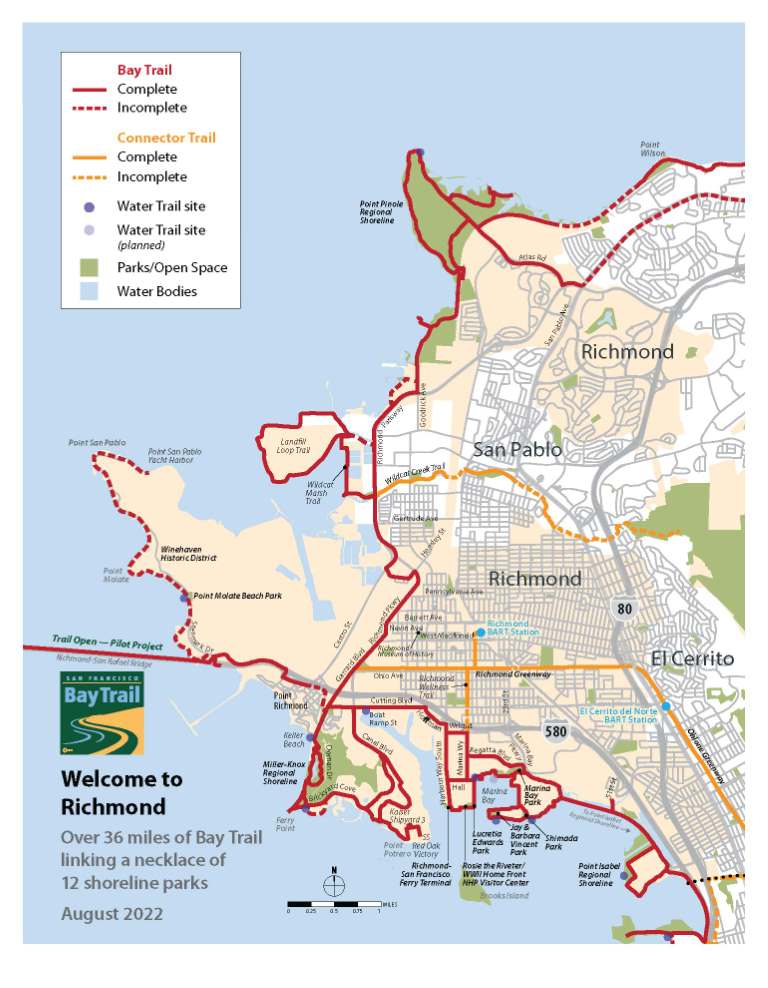
It was supposed to be a quick trip out to scenic Point Molate
before settling in for a family barbecue. But the ride ended abruptly
in a tangle of twisted metal and shattered lives on what may be
the most dangerous bicycle path in the Bay Area.
The accident, which killed Weinstein and
severely injured friend Dan Doellstedt, has raised serious questions
about the path, which runs along a narrow shoulder of westbound
Interstate 580 near the Richmond-San Rafael Bridge tollbooth.
An attorney for the Weinstein and Doellstedt families is blaming
Caltrans for creating a "death
trap" by providing bicyclists with little more protection than
a painted white line to separate them from speeding trucks and
cars.
Bay Trail activists say Chevron -- which owns property on both
sides of that section of freeway -- indirectly contributed to the
accident by refusing five years ago to allow a separated bicycle
and pedestrian path to be built on its land, claiming security
issues.
"We've been trying for years to get that bike path off the freeway,
but Chevron has refused to cooperate" says Bruce Beyaert, chairman
of Trails for Richmond Action Committee. "This accident was completely
unnecessary."
A tragic homecoming
Weinstein, 42, who moved to Australia 15 years ago, recently sold
his software engineering business to a multinational company. The
sale allowed him to enjoy some special time with his wife, Michelle,
and their two daughters, Micala, 8 and Emma, 4, on a six-week trip
to Europe and Mexico.
They were spending the last leg of the trip with family and friends
in Point Richmond, where Weinstein grew up.
On Sept. 24, Weinstein, Doellstedt and Richmond resident Michael
Meyer decided to go for a 40-minute ride to Point Molate before
the barbecue at Doellstedt's apartment.
"Out at Point Molate, we stopped at an overlook, talked for a
while and enjoyed the view before heading back." Meyer said. "I
was a couple of hundred feet ahead of the two Dans, near the end
of the freeway bike path. I slowed down to wait, and at that moment,
I heard brakes."
Meyer turned and saw a Toyota Camry veer across the bicycle lane,
collide with the freeway's outer concrete barrier, then bounce
back into the bicycle lane and crash head on into Weinstein and
Doellstedt at an estimated 65 mph.
I-580 was shut down in both directions while a helicopter landed
to take the two men to John Muir Medical Center in Walnut Creek.
Weinstein died two days later of major head injuries. Doellstedt,
41, remains on a respirator with two metal rods along a crushed
section of his spine. Physically, he can respond to simple commands
such as squeezing a hand, although he has not been able to move
his legs voluntarily.
The accident is still under investigation, but according to the
California Highway Patrol's preliminary interviews, 54-year-old
Albany resident Fayez El Giheny either swerved into the bicycle
lane to avoid another car that had cut him off or became distracted
and missed the freeway's sloping left turn.
A perilous path
That particular stretch of freeway is on the approach to the tollbooth,
and there are plenty of opportunities for distraction, Richmond
Councilman Tom Butt said. Butt's architectural firm, Interactive
Resources, adopted that portion of freeway from 1991 until earlier
this year.
"The conditions there are terrible for drivers, let alone bicyclists," Butt
said. "Trucks and cars are still driving 60 or 70 mph as they get
in position for the FasTrak lane or jockey for a spot in the tollbooth
lines. And at the same time, some drivers are frantically digging
in their pockets for the $3 toll."
There are no signs warning bicyclists of the dangers. Perhaps
more importantly, as El Giheny drove toward the tollbooth, he would
not have seen any signs alerting him to the possible presence of
bicyclists on the narrow shoulder.
The bike lane, which remains open, was designed according to regulations,
Caltrans spokesman Jeff Weiss said.
"We followed all regulations on all aspects of this bicycle lane,
though that can only provide cold comfort when there's been a tragedy
such as this accident," Weiss said. "The only requirement is
that we put signs at the bicycle lane's on-ramp and off-ramp. That's
regulation."
But Caltrans is trying to cover a colossal blunder, said San Francisco-based
attorney Chris Dolan, who represents the Weinstein and Doellstedt
families.
"Caltrans knows better. They failed to protect bicyclists by not
establishing barriers between them and the freeway," he said. "Caltrans
didn't even bother to place proper signage for both motorists and
bicyclists, nor did they install rumble strips to warn drivers
when they were drifting into the bike lane."
The lack of rumble strips creates a particularly hazardous condition.
In the area where the two cyclists were run down, the freeway's
outer concrete wall is marked with the gouges and scrapes of vehicles
that careened through the bike lane after missing the left turn.
Caltrans has left the freeway bike path open and there are as
yet no plans to add any additional safety features.
Chevron role
Bay Trail activists have been working for safe access to the San
Pablo peninsula for years. Chevron, the city of Richmond and the
Association of Bay Area Governments funded a path feasibility study
five years ago.
The 65-page study concluded that a $7 million bicycle and pedestrian
path with a cantilevered section over Chevron's Long Wharf pipes
would have been the best solution to the dangerous freeway bike
lane.
But Chevron backed away from the plan after the Sept. 11, 2001,
terrorist attacks, claiming security concerns. The Long Wharf pipes
pump about 250,000 barrels of crude oil into the refinery daily,
Chevron Security Manager Mark Ayers said. If those pipes were somehow
sabotaged, the effects would be felt throughout California and
the Pacific Northwest.
"The bicycle path would have gone over a major operations area,
and we can't have that," Ayers said. "Any increase in public access
softens us as a target, and we need to remain a hard target."
That's a dodge, said Beyaert, the Richmond trails committee chairman:
About 75,000 vehicles pass over those pipes each day on I-580,
and the Long Wharf pipes are easily accessible from the existing
eastbound bicycle lane and a parking area where truckers frequently
pull over for short naps.
"A hundred or so bicyclists and pedestrians in an enclosed path
each day would not make any difference." Beyaert said. "Chevron
doesn't identify with the Bay Trail or providing safe access to
Point Molate, and they're searching for reasons to say 'no.'"
Michelle Weinstein has returned to Australia and is doing her
best to create a sense of normalcy for her two daughters. Micala
and Emma are in school and are spending a lot of time with her
close-knit family, said Michelle's brother, Peter Macisaac.
"The most important thing for us," Macisaac said, "is
that a needless accident like this one doesn't happen to anyone
else."
Karl Fischer contributed to this story. Reach John Geluardi at
510-262-2787 or jgeluardi@cctimes.com.
ABOUT ESTABLISHING A SAFE BICYCLE AND PEDESTRIAN PATH TO POINT
MOLATE
FOR DETAILS
Trails For Richmond Action Committee
E-MAIL: tracbaytrail@earthlink.net
ONLINE: www.pointrichmond.com/baytrail |